Graduate Research Project
Deep Eutectic Solvent Study
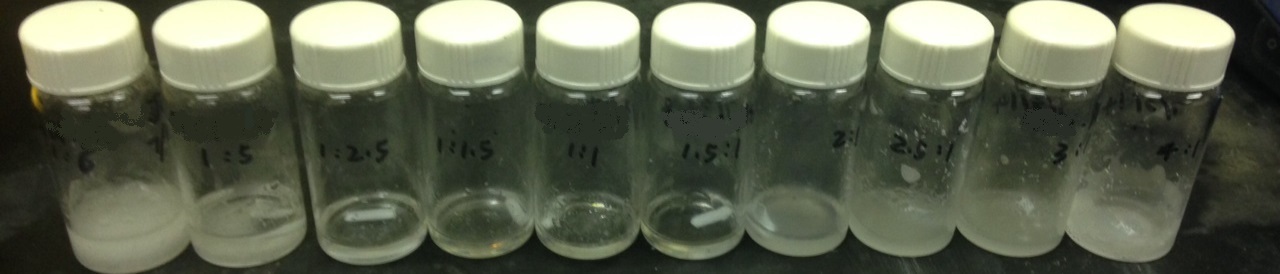
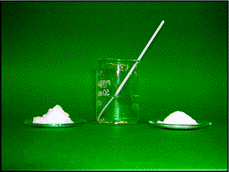
Andrew P. Abbott et. al, Journal of the American Chemical Society, 2004. 126(29): p. 9142-9147.
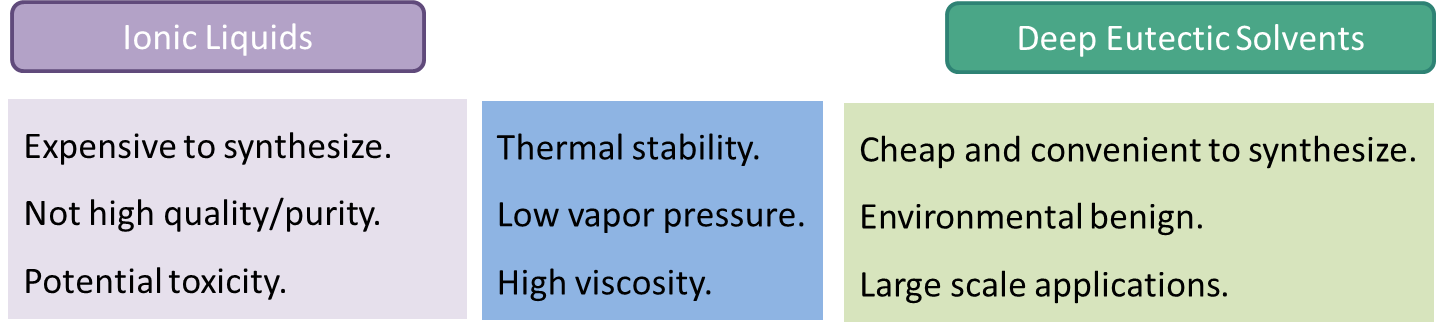
In the year of 2003, Abbott and coworkers reported a new kind of solvents formed of choline chloride and urea, and they called it deep eutectic solvents (DES), which was considered to be a sub-category of ILs. The freezing point for the mixture of two components at a certain ratio is smaller than each of the individual component. Some DES has the eutectic temperature lower than room temperature, so they can keep at the liquid state like some room temperature ionic liquids (RTILs). DES also share some common properties with ILs, like high viscosity, low vapor pressure and thermal stability, so they are given great hope for various applications like ILs. Compared with ILs, DES has the advantages of preparation simplicity, economy and friendly environmental effect, which are exactly the problems that ILs face. The method of preparing DES is to simply mix two components at certain ratio by heating it a little bit (usually 60-80 °C) to get a clear liquid. As long as the two components are mixed at the eutectic ratio, there’s no purity or quality problem for DES. The forming of DES is because of the molecule interaction (e.g. hydrogen bond) instead of chemical reactions, so the preparation process is cheap and energy saving. The ingredients for DES preparation are also commonly used chemicals, which are cheap and biodegradable, so DES is the real environmental benign solvent. Due to the unbeatable advantages of DES, it is considered to be the new generation of solvent, and a variety of experiments coupled with mechanism studies are currently in process by a lot of groups all over the world.
The forming of DES is currently considered to be the hydrogen bond formation between some quaternary amine salt and some hydrogen bond donors. One mentionable property of ILs that contributes to the diversity of IL functions is the designable property of ILs by combining different cations and anions; it can also be applied to DES. Therefore, DES is also designable by changing one or both of the two components or some functional groups in the components to achieve the desired function. From the studies until now, DES do function like ILs as expected in some applications. With the concept of DES, researchers have successfully utilize it for a lot of applications like separation processes, nano materials and polymer sciences.
- University of Missouri - Columbia, Department of Chemical Engineering, 01/2014 - Present
- Collaborated with Dr. Qingsong Yu and Nanova Biomaterials, Inc..
- Patent in preparation. Manuscripts are finished and ready to submit. More information will be disclosed in the future.
Advisor: Dr. Sheila Baker
